

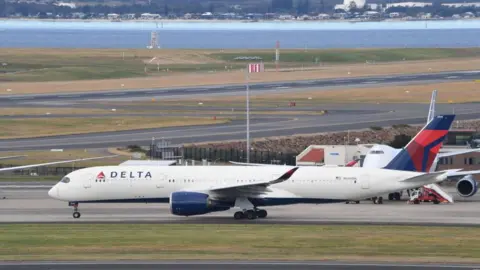
A number of individuals have been injured when a Delta Airlines flight from LA to Sydney, Australia encountered turbulence Friday morning.
Delta Flight 41 "went through a short bout of rough air" as it touched down at the Sydney airport, a representative for the carrier told. Four flight attendants required medical attention.
Local paramedics reported they treated five patients, and took three of them to the hospital with relatively minor issues that such as back pain and headaches. The patients' ages ranged from their thirties and seventies.
This marks the latest incident of aircraft experiencing turbulence, with aviation specialists saying that global warming is a significant contributor.
There were nearly 250 travelers and 15 crew members on the Airbus A350, the representative added, adding that the plane arrived "safely" at Sydney Airport at shortly before 7 a.m. on Friday.
Emergency responders reported they received a call just only 180 seconds ahead of the plane arrived, and response teams were standing by on the runway.
Why plane turbulence is getting increasingly prevalent - and often stronger.
During the past year, 25 people were hurt when another Delta jet, on a route from Salt Lake City to Amsterdam, encountered "significant" atmospheric disturbance just two hours into the lengthy trip, and was forced to make an emergency landing.
Recently, passengers and crew on a certain international flight endured a frightening brief five-second period of extreme instability. One passenger lost their life and numerous people sustained injuries, as unbelted passengers were thrown from their seats and fell back down.
Bumpy air is fairly routine while flying, and while cases of rough conditions are reportedly becoming more frequent, they are remained quite uncommon.
Research indicates that there are an estimated 5,000 incidents of significant in-flight disturbance each year, out of a sum of over 35 million flights that are conducted around the world.
Strong atmospheric disturbance is described as when the up and down movements of a aircraft experiencing disturbed air generate in excess of a significant G-force on your body - enough to propel you from your seat if you weren't wearing a seatbelt.
As climate change modifies the conditions in the sky, researchers alert that air travel could become less smooth: warming trends and changing jet streams in the upper atmosphere are likely to increase the occurrence and strength of significant turbulence.
